
Hirschsprung’s disease is a rare condition that affects the large intestine and mainly appears in newborn babies and young children. It happens when certain nerve cells in the colon are missing, making it difficult for the bowel to move stool normally. As a result, children may suffer from severe constipation, abdominal swelling, and other digestive problems. Understanding Hirschsprung’s disease, its symptoms, causes, and treatment options can help parents recognize the problem early and seek proper medical care.
The Science Behind Hirschsprung’s Disease
To get a handle on what goes wrong in Hirschsprung’s disease, it helps to first understand how our digestive system is supposed to work. Think of it as a long, winding tube that starts at your mouth and ends, well, at the other end. Its main job is to take the food you eat, pull out all the good stuff (nutrients and water), and get rid of the waste.
The large intestine, or colon, is the final stop on this journey. It’s a muscular tube, and its walls are lined with special nerve cells. These nerves act like traffic controllers, telling the muscles when to squeeze and push waste along. This coordinated squeezing motion is called peristalsis, and it’s what keeps everything moving smoothly toward the exit.
So, what happens with Hirschsprung’s disease? In the simplest terms, a section of the large intestine is missing these crucial nerve cells. During a baby’s development in the womb, these nerve cells are supposed to grow all the way down the intestine. For some reason, in babies with this condition, the cells stop growing before they reach the end. This leaves a part of the colon, usually near the rectum, without the “traffic controllers” it needs to function.
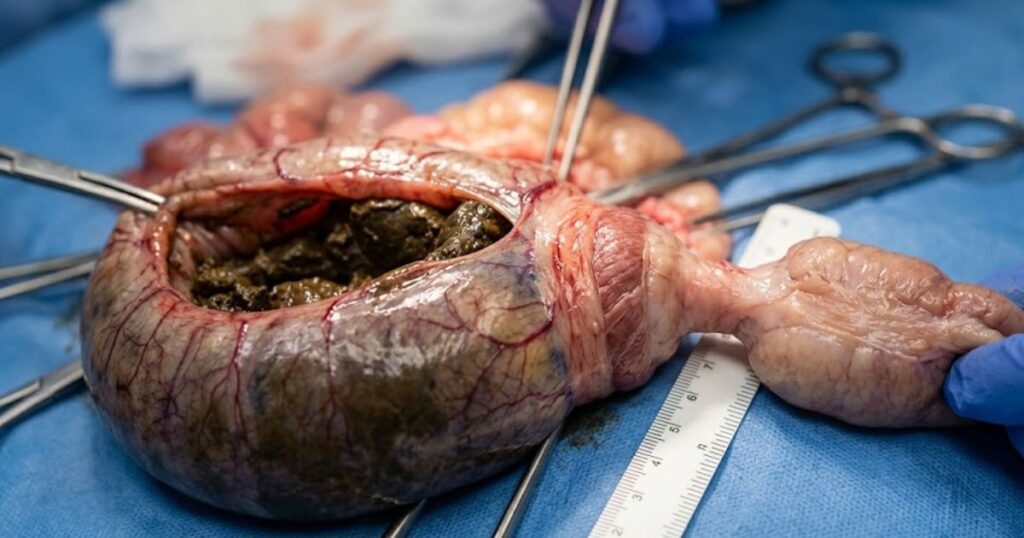
Without these nerve cells, the affected part of the intestine can’t relax and squeeze properly. Instead, it stays tight and narrow, creating a blockage. Stool can travel down the healthy part of the colon but gets stuck when it hits this non-functioning section. This leads to a backup, causing the intestine above the blockage to swell up with trapped stool, gas, and fluid. This is what causes the main symptoms associated with the condition.
What Causes Hirschsprung’s Disease?
One of the first questions parents ask is, “Why did this happen?” The honest answer is that doctors aren’t entirely sure what causes Hirschsprung’s disease. It’s not something a parent did or didn’t do during pregnancy. It’s a developmental issue that happens very early on.
For a long time, the cause was a complete mystery. Today, we know that genetics play a role. Is Hirschsprung’s disease genetic? Sometimes, yes. Researchers have identified several gene mutations that can increase the risk of a child developing the condition. This explains why it sometimes runs in families. If you have one child with the condition, there’s a slightly higher chance that future children could have it, too.
However, most cases happen in families with no history of the disease. This suggests that it’s often caused by a combination of genetic factors and other unknown environmental influences.
While anyone can be born with this condition, some factors increase the risk. Boys are about four times more likely to have it than girls. It’s also more common in children who have other inherited conditions, such as Down syndrome or certain types of congenital heart disease. It’s important to remember that these are just risk factors, not direct causes.
Symptoms Across Different Age Groups
The signs of Hirschsprung’s disease can look different depending on how old a child is and how much of the intestine is affected.
In newborns, the symptoms are often noticeable within the first day or two of life. The most classic sign is a baby not having their first bowel movement (called meconium) within 48 hours of birth. While many healthy babies might take their time, its absence is a significant red flag for doctors.
Other symptoms in newborns can include:
- A swollen, tight belly
- Vomiting, which might be green or brown
- Fussiness or crying from discomfort
- Refusing to eat
But how does Hirschsprung’s disease present in older children? In milder cases, the condition might not be diagnosed right away. An infant might just seem to have severe constipation. As they get older, the symptoms can become more persistent.
In toddlers and older kids, you might see:
- Chronic, severe constipation that doesn’t get better with standard treatments
- A swollen abdomen
- Passing small, watery stools (as liquid seeps around the hard, stuck stool)
- Poor appetite and failure to gain weight or grow properly
- Feeling tired all the time
In extremely rare cases, the condition isn’t diagnosed until the teenage years or even adulthood. These individuals have likely struggled with severe bowel issues their entire lives, often without a clear diagnosis.
How Is Hirschsprung’s Disease Diagnosed?
If a doctor suspects Hirschsprung’s disease, they will use a few different methods to confirm it. The process usually starts with a physical exam. The doctor will feel the baby’s belly to check for swelling and may perform a rectal exam to see if the rectum feels unusually tight or empty of stool.
After the initial exam, what tests are used to confirm the condition? There are three main diagnostic tools:
- Abdominal X-ray: This is often the first step. A simple X-ray can show if there are signs of a bowel blockage, like a swollen colon and a lack of air in the rectum. Sometimes, a special type of X-ray called a contrast enema is used. For this test, a safe liquid dye is placed into the colon through the rectum. The dye shows up on the X-ray, highlighting the shape of the intestine and clearly showing the narrow, blocked section and the dilated, swollen part above it.
- Anorectal Manometry: This test is usually for older children, not newborns. It measures how the muscles and nerves in the rectum respond to pressure. A small balloon is inserted into the rectum and gently inflated. In a healthy person, the muscles of the rectum relax automatically. In a person with Hirschsprung’s, this relaxation reflex doesn’t happen.
- Rectal Biopsy: This is the gold standard for diagnosis. It’s the only way to be 100% sure. The doctor takes a tiny sample of tissue from the lining of the rectum using a special suction tool. The procedure is quick and doesn’t require general anesthesia. The tissue sample is then examined under a microscope. A pathologist looks for the presence of ganglion nerve cells. If no nerve cells are found, the diagnosis of Hirschsprung’s disease is confirmed.
Exploring Treatment Options
Once a diagnosis is confirmed, the next step is treatment. Because the affected part of the intestine cannot function, the only effective treatment is surgery to remove or bypass it. The goal of surgery is to connect the healthy part of the intestine to the anus, allowing stool to pass normally.
There are two main surgical approaches:
- Pull-Through Procedure: This is the most common surgery. The surgeon removes the section of the large intestine that is missing nerve cells. Then, they “pull through” the healthy part of the colon and attach it directly to the anus. In many cases, this can be done using minimally invasive techniques (laparoscopy), which involves small incisions, less pain, and a quicker recovery.
- Ostomy Surgery: Sometimes, the surgery is done in two stages. This is often necessary if the baby is very sick, has a severely swollen colon, or has an infection called enterocolitis. In the first stage, the surgeon performs an ostomy. They remove the diseased part of the colon and bring the end of the healthy intestine to an opening created on the abdomen, called a stoma. Stool then passes out of the body through the stoma and into a special bag. This gives the lower part of the intestine time to heal and for the child to grow stronger. A few months later, a second surgery (the pull-through procedure) is performed to connect the intestine to the anus and close the stoma.
What about non-surgical management? Unfortunately, because the problem is a physical absence of nerves, there is no medication or diet that can cure the condition. Bowel management with enemas and laxatives may be used temporarily before surgery but is not a long-term solution.
Over the years, advances in surgical techniques have made a huge difference. Surgeons can now perform these procedures more safely and with better outcomes, even in the smallest of infants.
Post-Surgery Care and Recovery
The recovery period after surgery is a critical time. After a pull-through procedure, your child will stay in the hospital for a few days so the medical team can monitor them. They will be given pain medication to stay comfortable and will slowly start eating again.
What should you expect after surgery? At first, bowel movements may be frequent and loose. The skin around the anus can become irritated, so it’s important to keep the area clean and dry and use a protective diaper cream. Your surgical team will give you specific instructions on how to care for your child.
While surgery is highly successful, some children may face challenges. Tips for managing post-surgery complications are key. Some kids might continue to struggle with constipation because the remaining intestine has to adapt. Others might have trouble with fecal incontinence (accidents).
One of the most serious potential complications is enterocolitis, an inflammation of the intestines. It can happen before or after surgery and requires immediate medical attention. Symptoms include fever, a swollen belly, vomiting, and foul-smelling, explosive diarrhea. If you notice any of these signs, contact your doctor right away.
Living with Hirschsprung’s Disease
The big question for many parents is, “What does the future hold?” With proper medical care, the long-term outlook for children with Hirschsprung’s disease is excellent. Most children go on to live full, healthy, and active lives. They can eat a normal diet, play sports, and do everything their friends can do.
Managing bowel function can sometimes be a lifelong journey. Some children may need to follow a special bowel management program, which might include a high-fiber diet, plenty of fluids, and sometimes medications or enemas to stay regular. Potty training might take a little longer for some kids, but with patience and support, they get there.
Emotional and practical support for families is just as important as medical care. Connecting with other families who have been through a similar experience can be incredibly helpful. There are many online support groups and organizations dedicated to providing resources and a sense of community. Don’t be afraid to lean on your support system of family, friends, and healthcare providers.
Raising Awareness and Moving Forward
Hirschsprung’s disease may not be a household name, but for the 1 in 5,000 families it affects, it’s a daily reality. Raising awareness is crucial because early detection makes all the difference. When parents and pediatricians are aware of the early warning signs, a diagnosis can be made quickly, preventing the child from getting very sick.
You can help support Hirschsprung’s disease awareness campaigns by sharing accurate information, participating in fundraisers, or simply talking about your experience. Your story has the power to help another family navigate their own journey.
A diagnosis of Hirschsprung’s disease can feel like a heavy burden, but knowledge is power. By understanding the condition, knowing the treatment options, and building a strong support network, you can confidently manage your child’s health. Most importantly, remember that this condition does not define your child. With the right care, they have a bright and healthy future ahead of them. For more information, consider reaching out to organizations like the American Pediatric Surgical Association (APSA) or dedicated family support groups. You are not alone on this path.
Conclution
Hirschsprung’s disease is a rare but serious condition that affects the large intestine and mainly appears in newborns and young children. It occurs when nerve cells are missing in parts of the colon, making it difficult for stool to move normally through the bowel. Early diagnosis is very important because untreated cases can lead to severe complications. Fortunately, with proper medical care and surgery, most children can live healthy and normal lives. Understanding the symptoms and seeking timely treatment can make a big difference in managing Hirschsprung’s disease effectively.
FAQs
Can Hirschsprung’s disease be prevented?
No, there is currently no known way to prevent Hirschsprung’s disease. It’s a condition that develops before birth, and it’s not caused by anything a parent did. The focus is on early diagnosis and effective treatment.
What should I do if my child shows symptoms?
If your newborn hasn’t passed a stool in 48 hours or if your child of any age is showing signs of severe constipation, a swollen belly, or vomiting, it’s important to contact your pediatrician right away. Early detection is key to preventing serious complications.
