
CIDP (chronic inflammatory demyelinating polyneuropathy) is a rare autoimmune disorder where your immune system mistakenly attacks myelin, the protective coating around your peripheral nerves. This causes slowly worsening weakness, numbness, and fatigue in your arms and legs over at least eight weeks. CIDP isn’t curable, but it’s treatable and most people respond well to therapy.
What Is CIDP?
CIDP stands for chronic inflammatory demyelinating polyneuropathy (sometimes called polyradiculoneuropathy). It’s a rare, long-term autoimmune condition that damages the myelin sheath, the fatty, protective layer wrapped around your peripheral nerves, the nerves outside your brain and spinal cord.
When myelin gets damaged, nerve signals slow down or stop reaching their destination. That’s what causes the hallmark symptoms: weakness, numbness, and tingling that usually show up on both sides of your body.
CIDP isn’t something you catch, and it isn’t passed down through your genes. Researchers still aren’t sure exactly what triggers it, but they know the immune system plays the central role.
Breaking Down the Name
Understanding CIDP gets easier once you break the term into its four parts:
- Chronic the condition develops slowly, over at least eight weeks, and can persist or return (relapse) for months or years.
- Inflammatory an autoimmune reaction causes inflammation that damages nerve tissue.
- Demyelinating the inflammation specifically targets and strips away myelin.
- Polyneuropathy “poly” means many; this means many peripheral nerves are affected throughout the body.
What Are the Symptoms of CIDP?
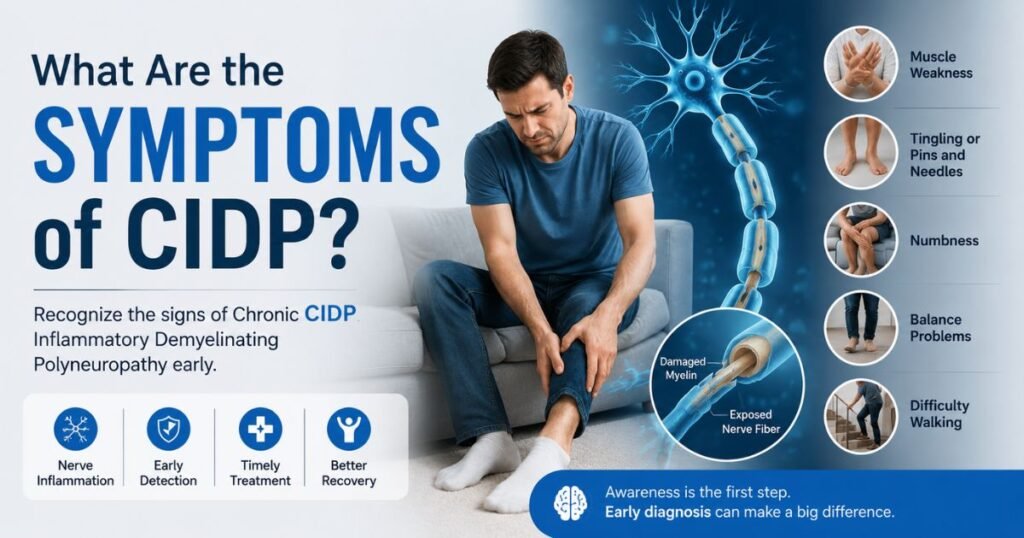
Symptoms vary by CIDP subtype, but the most common pattern is muscle weakness that builds gradually over two months or more, usually affecting both sides of the body equally. It typically shows up in the:
- Hips and thighs
- Shoulders and upper arms
- Hands
- Feet
Other symptoms you might notice:
- Loss of muscle bulk in affected areas
- Tingling, prickling, or numbness in fingers and toes
- Balance problems and clumsiness
- Reduced or absent reflexes
- Nerve-related pain
- Fatigue
What Causes CIDP?
The honest answer: nobody knows exactly. What’s understood is that CIDP is an autoimmune condition for reasons that aren’t fully clear, the immune system starts treating myelin as a threat and attacks it. There’s no known genetic cause and no confirmed environmental trigger, unlike Guillain-Barré syndrome, which is often linked to a preceding infection.
CIDP vs. Guillain-Barré Syndrome (GBS) What’s the Difference?
CIDP and GBS are often described as siblings; both are autoimmune attacks on peripheral nerve myelin, but they behave very differently over time.
| CIDP | GBS | |
| Onset | Gradual symptoms build over 8+ weeks | Rapid symptoms peak within 2–3 weeks |
| Duration | Chronic; can relapse over months or years | Usually a single episode |
| Trigger | Not typically linked to infection | Often follows an infection (e.g., a stomach bug) |
| Recovery pattern | Ongoing management; may need continued treatment | Most people recover substantially after treatment |
| Treatment overlap | IVIG, plasma exchange, corticosteroids | IVIG, plasma exchange (steroids don’t help GBS) |
Is CIDP the Same as GBS?
No. Healthcare providers often describe CIDP as the chronic, longer-lasting cousin of GBS; in rare cases, someone who doesn’t fully recover from GBS can go on to develop CIDP. But as standalone conditions, they differ in how they start, how long they last, and what typically triggers them.
Types (Variants) of CIDP
Not everyone with CIDP has the same symptom pattern. Typical CIDP symmetric weakness plus sensory symptoms on both sides of the body is the most common form. Atypical variants include:
| Variant | Key Feature |
| Multifocal motor neuropathy (MMN) | Asymmetric muscle weakness only, no sensory symptoms |
| Lewis-Sumner syndrome | Asymmetric weakness plus sensory symptoms |
| Pure sensory CIDP | Numbness, pain, and balance issues; no weakness |
| Pure motor CIDP | Symmetric weakness and reflex loss; no sensory symptoms |
| Distal CIDP | Weakness and sensory loss mainly in the legs |
| Focal CIDP | Symptoms limited to one arm or leg |
Researchers continue to study additional CIDP variants as diagnostic tools improve.
How Is CIDP Diagnosed?
CIDP can be tricky to diagnose because its variants look different from person to person and can resemble other neuropathies. Diagnosis typically follows these steps:
- Medical history and symptom review your provider asks about onset, pattern, and progression.
- Physical and neurological exam checking reflexes, strength, and sensation.
- Electromyography (EMG) and nerve conduction studies detect the specific slowing and signal blocks that point to demyelination rather than other nerve damage.
- Lumbar puncture (spinal tap) most people with CIDP show elevated protein in cerebrospinal fluid with a normal white blood cell count.
- MRI of the lumbar spine contrast uptake in nerve roots can support a CIDP diagnosis.
- Blood tests to rule out other causes of neuropathy, like diabetes, thyroid disease, or vitamin deficiencies.
- Nerve biopsy used rarely, when other results are inconclusive.
How Is CIDP Treated?
There’s no cure for CIDP, but most people respond well to treatment. First-line options include:
- Corticosteroids (like prednisone) reduce inflammation; effective for many people, though long-term use carries side-effect risks.
- Intravenous immunoglobulin (IVIG) donor-derived antibodies that calm the immune attack on nerves; often need repeat infusions over time.
- Plasma exchange (plasmapheresis) filters harmful antibodies out of the blood; effects tend to be temporary, so many people need ongoing sessions.
The Newest CIDP Treatment: Efgartigimod (Vyvgart Hytrulo)
This is where the CIDP treatment landscape has genuinely changed. In June 2024, the FDA approved efgartigimod alfa and hyaluronidase-qvfc (Vyvgart Hytrulo) for adults with CIDP the first new class of CIDP treatment to reach approval in more than three decades, and the first FcRn (neonatal Fc receptor) blocker approved for this condition.
Instead of broadly suppressing the immune system like steroids do, efgartigimod works by blocking FcRn, a receptor that normally helps recycle IgG antibodies in the body. By blocking it, the drug lowers circulating levels of the harmful IgG antibodies believed to attack myelin while leaving other parts of the immune system largely untouched. It’s given as a weekly subcutaneous injection that takes roughly 30 to 90 seconds to administer.
The approval was based on the ADHERE trial, described by its manufacturer as the largest clinical trial conducted on CIDP to date, which measured improvement using the Inflammatory Neuropathy Cause and Treatment (INCAT) disability score. As of 2026, other FcRn inhibitors including rozanolixizumab and nipocalimab are FDA-approved for related neuromuscular autoimmune conditions, though efgartigimod remains the only one specifically approved for CIDP.
This is a fast-moving treatment area that always confirms current FDA-approved options and eligibility with a neurologist, since approvals and guidelines can change.
Is CIDP Fatal? What’s the Life Expectancy?
CIDP is not considered a fatal condition, and people diagnosed with it typically have a similar life expectancy to those without it. Left untreated, however, CIDP can lead to permanent nerve damage and disability which is why early diagnosis and treatment matter. In rare cases, CIDP can affect the muscles used for breathing; trouble breathing is a medical emergency and needs immediate care.
How Rare Is CIDP?
CIDP is genuinely rare, though exact prevalence estimates vary depending on the study and region, a reflection of how difficult the condition is to diagnose consistently. Estimates of new cases range from roughly 1 to 9 per 100,000 people per year in the United States, and total prevalence estimates across patient organizations range from around 24,000 to 60,000 Americans living with the condition. CIDP can affect anyone at any age, though it’s somewhat more common in men, particularly those in their 40s through 60s.
What a CIDP Diagnosis Journey Actually Looks Like
Because CIDP mimics other neuropathies, it’s common for people to see more than one specialist before getting a firm diagnosis, often starting with a primary care provider, then a neurologist, and sometimes a neuromuscular specialist for EMG testing and interpretation. Bringing a written symptom timeline to appointments (when weakness started, which limbs, whether it’s gotten better or worse) tends to speed up the process significantly, since CIDP is diagnosed largely on symptom pattern and test results rather than a single definitive test.
Conclusion
Chronic Inflammatory Demyelinating Polyneuropathy (CIDP) is a rare but treatable neurological disorder that affects the peripheral nerves. Early diagnosis and timely treatment can significantly improve symptoms, prevent long-term nerve damage, and enhance quality of life. If you experience persistent muscle weakness, numbness, or difficulty walking, it’s important to seek medical evaluation promptly. With proper treatment, rehabilitation, and ongoing care, many people with CIDP can effectively manage the condition and maintain an active, independent lifestyle.
FAQs
What are the first signs of CIDP?
The earliest signs are usually gradual weakness and numbness in the feet and hands, often with balance trouble or fatigue, that builds over weeks rather than appearing suddenly.
Is CIDP the same as Guillain-Barré syndrome?
No. They’re related to autoimmune nerve conditions, but GBS comes on quickly and is usually a one-time event, while CIDP develops slowly and is typically an ongoing, chronic condition.
Can CIDP be cured?
There’s currently no cure, but CIDP is treatable. Many people see significant improvement with corticosteroids, IVIG, plasma exchange, or the newer FcRn-inhibitor therapy, efgartigimod.
Is CIDP fatal?
CIDP itself is not considered fatal, and treated patients generally have a normal life expectancy. Untreated, it can lead to permanent disability, so early treatment matters.
How rare is CIDP?
It’s a rare disease, with U.S. estimates ranging from about 1 to 9 new cases per 100,000 people each year, depending on the study.
What triggers a CIDP flare-up?
Researchers haven’t identified a specific, universal trigger CIDP can worsen or relapse without a clear cause, which is part of why ongoing monitoring with a neurologist matters.
