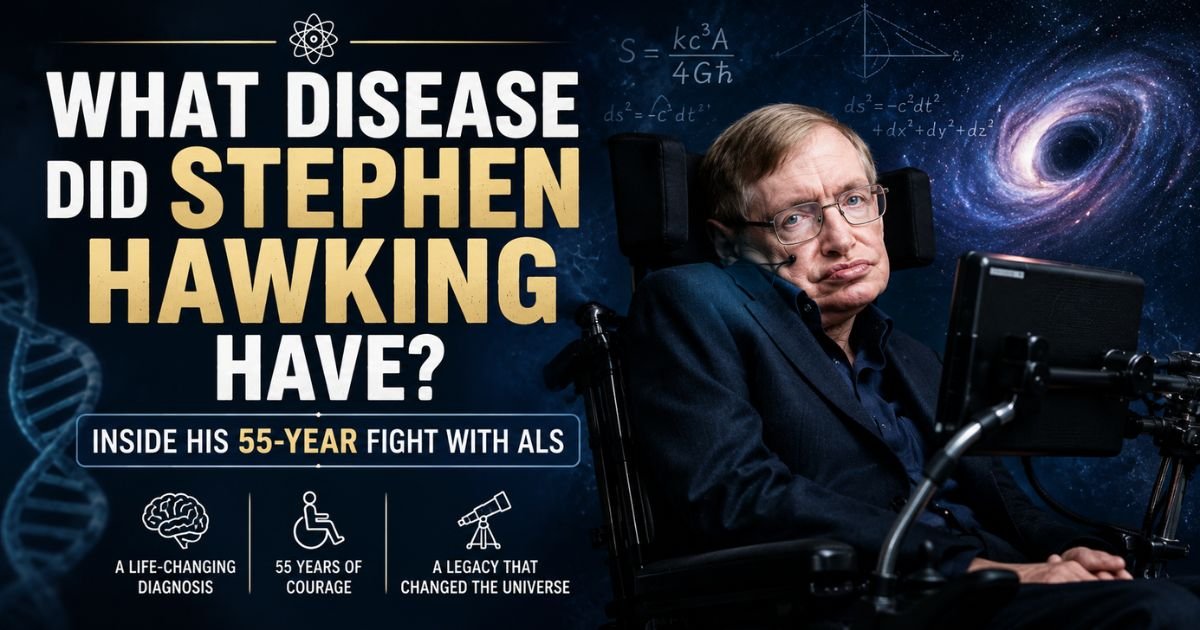
Stephen Hawking had amyotrophic lateral sclerosis (ALS), also known as motor neuron disease or Lou Gehrig’s disease. He was diagnosed in 1963 at age 21, while a graduate student at Cambridge. ALS gradually destroys the nerve cells that control voluntary muscle movement. Most patients die within 3–5 years of diagnosis; Hawking survived 55 years, making him one of the longest-living ALS patients ever documented.
What Is ALS (Amyotrophic Lateral Sclerosis)?
ALS is a progressive neurodegenerative disease that attacks motor neurons the nerve cells in the brain and spinal cord responsible for controlling voluntary muscles like those used for walking, talking, chewing, and breathing.
As these neurons die off, the muscles they control weaken, stiffen, and eventually stop responding altogether. The disease doesn’t affect the senses, and in most cases it leaves memory and personality intact Hawking’s own trajectory, where his mind stayed razor-sharp while his body failed, is the textbook illustration of this.
In the U.S., ALS is more commonly called Lou Gehrig’s disease, after the New York Yankees first baseman whose 1939 diagnosis brought national attention to the condition.
How ALS Affects the Body
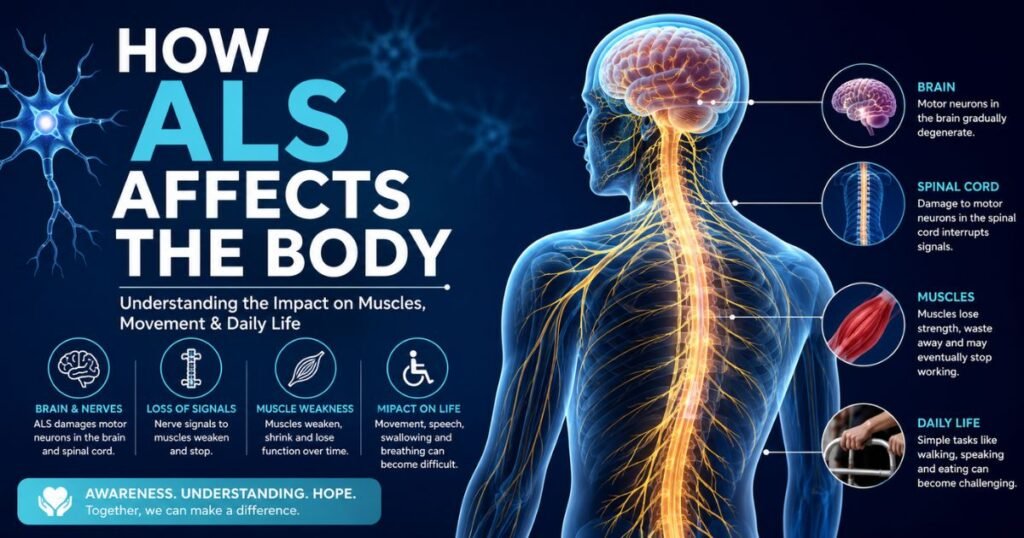
ALS damages two types of motor neurons, and the mix determines a patient’s specific symptoms:
- Upper motor neurons located in the brain, they signal the spinal cord to trigger movement. Damage here causes stiffness, spasticity, and exaggerated reflexes.
- Lower motor neurons located in the spinal cord and brainstem carry signals directly to muscles. Damage here causes muscle weakness, twitching (fasciculations), and wasting (atrophy).
Most ALS patients experience a mix of both, and the disease typically follows this pattern:
- Early symptoms clumsiness, muscle weakness, slurred or slowed speech, occasional stumbling
- Progressive weakness loss of fine motor control in the hands, difficulty writing or buttoning clothes
- Mobility loss inability to walk without support, eventual need for a wheelchair
- Speech and swallowing decline difficulty forming words, risk of choking, weight loss from reduced food intake
- Respiratory failure weakening of the diaphragm, the leading cause of death in ALS
ALS vs. Other Motor Neuron Disorders
ALS is the most common motor neuron disease, but it’s not the only one. Clinicians also recognize:
| Condition | What It Affects | Typical Presentation |
| ALS | Both upper and lower motor neurons | Combined weakness, stiffness, and muscle wasting |
| Primary Lateral Sclerosis (PLS) | Primarily upper motor neurons | Stiffness and spasticity; slower progression |
| Progressive Muscular Atrophy (PMA) | Primarily lower motor neurons | Muscle wasting and twitching without spasticity |
Neurologists note that these categories can blur autopsy findings often show some degeneration in both neuron types even when a patient’s clinical picture pointed to just one.
When Was Stephen Hawking Diagnosed?
Hawking’s first symptoms of clumsiness and a fall down a flight of stairs appeared during his final year at Oxford. By 1963, while starting graduate work in cosmology at Cambridge, doctors confirmed the diagnosis: ALS, with a prognosis of roughly two years.
He was 21. He would go on to live until age 76, dying on March 14, 2018.
Why Did Stephen Hawking Live So Long with ALS?
There’s no single confirmed explanation but neurologists who’ve studied his case point to a combination of factors, not one silver bullet.
Juvenile-onset ALS often progresses more slowly. Most ALS patients are diagnosed after age 50 and typically survive 3–5 years. Hawking’s diagnosis at 21 placed him in a much rarer, younger-onset category that tends to follow a slower, more variable course though physicians are careful to say this isn’t a guarantee, just a pattern seen in some younger patients.
His disease may have spared critical muscle groups longer than usual. Survival in ALS largely comes down to two systems: the diaphragm (breathing) and the swallowing muscles. Patients who lose these functions early face the highest risk of death from respiratory failure or malnutrition. Hawking’s slower decline in these specific areas bought him decades that most patients never get.
Exceptional round-the-clock care mattered enormously. Neuromuscular specialists who treated ALS patients around the same era have pointed out that Hawking had access to consistent nursing care, a feeding tube to prevent malnutrition, and after a near-fatal pneumonia episode in 1985 a tracheostomy and mechanical ventilation that most patients with ALS never receive. Fewer than 1 in 10 ALS patients choose invasive ventilation, largely because of its cost and caregiving demands.
Taken together, doctors describe him less as proof of a treatment breakthrough and more as a genuine medical outlier a case that shows what’s biologically possible in ALS, even if it isn’t typical.
How Long Can You Live with ALS?
ALS life expectancy is highly variable, but most patients survive 2–5 years after diagnosis. According to figures cited by ALS specialists, roughly half of patients live at least 3 years past diagnosis, about 20% live 5 years or more, and only around 5–10% survive a decade or longer. Survival beyond 20 years, like Hawking’s, is exceptionally rare and usually tied to younger onset, slower progression, and intensive medical support.
How Did Stephen Hawking Communicate?
As ALS progressed, Hawking’s ability to speak and move deteriorated in stages and his communication method evolved right along with it:
- Early progression he could still speak, though increasingly slurred, and used a wheelchair for mobility
- 1985 tracheostomy after a severe bout of pneumonia, doctors performed an emergency tracheostomy that saved his life but permanently removed his ability to speak
- Early speech synthesizer he initially communicated by selecting words from a screen using hand movements, spelling out sentences that a synthesizer then read aloud
- Cheek-switch system as his hand function declined, he switched to a system operated by twitching a single cheek muscle, which selected letters and words on a screen
- Signature computerized voice the American-accented synthesized voice became so associated with him that he kept using it even when newer, more natural-sounding technology became available
What Causes ALS? The Genetics Behind It
For most patients, the exact cause of ALS remains unknown researchers call these “sporadic” cases. But roughly 10% of ALS cases are inherited, linked to specific gene mutations, including:
- SOD1 one of the first genes linked to familial ALS, affecting how cells manage oxidative stress
- C9orf72 the most common genetic cause of both ALS and frontotemporal dementia
- TARDBP linked to abnormal protein buildup inside motor neurons
Genetic testing wasn’t available when Hawking was diagnosed in 1963, and it’s not publicly known whether he was ever tested. What is documented is that his ALS involved both upper and lower motor neuron damage, consistent with a classic ALS presentation rather than one of its rarer variants.
What Hawking’s Case Still Teaches ALS Researchers
Hawking’s five-decade survival didn’t come from a treatment other patients lack no drug or therapy explains it. What it demonstrated is how wide the biological range of a single disease label can be.
Researchers studying long-term ALS survivors have pointed to differences in which motor neurons resist degeneration longest. Neurons controlling eye movement, for instance, tend to be far more resistant to ALS damage than those controlling limb or respiratory muscles a clue some scientists believe could eventually point toward what protects certain cells and not others.
Common Misconceptions About ALS
- “ALS only affects movement.” False for some patients around 10% develop frontotemporal degeneration affecting language, behavior, or planning, sometimes progressing to dementia.
- “ALS is always fatal within a few years.” Usually true, but not always Hawking’s case, and a small number of others, show meaningful exceptions exist.
- “ALS affects thinking and memory in everyone.” False as a rule most ALS patients retain full cognitive function, which is part of what made Hawking’s continued scientific output possible.
- “There’s nothing you can do once diagnosed.” Misleading feeding tubes, ventilation support, and specialized care don’t cure ALS, but they demonstrably extend survival and quality of life.
Read More: How to Cure Gum Disease Without a Dentist Naturally
Conclusion
Stephen Hawking lived with amyotrophic lateral sclerosis (ALS), also known as motor neurone disease (MND), for more than five decades—far longer than most people diagnosed with the condition. His life demonstrated that while ALS is a serious progressive neurological disease, individuals can continue to make extraordinary contributions with the right medical care, assistive technology, and support. Hawking’s legacy continues to inspire millions through his scientific achievements and remarkable resilience.
FAQs
What disease did Stephen Hawking have?
Stephen Hawking had amyotrophic lateral sclerosis (ALS), a progressive disease that destroys the motor neurons controlling voluntary muscle movement. It’s also known as motor neuron disease or Lou Gehrig’s disease.
How old was Stephen Hawking when he was diagnosed?
He was 21, diagnosed in 1963 during his first year of graduate study at Cambridge, after doctors traced his worsening clumsiness and slurred speech back to ALS.
How long did Stephen Hawking live with ALS?
He lived with ALS for 55 years, from his 1963 diagnosis until his death in 2018 at age 76 despite an initial prognosis of about two years.
Is ALS hereditary?
About 10% of ALS cases are inherited, linked to gene mutations like SOD1, C9orf72, and TARDBP. The remaining 90% are considered sporadic, with no clear genetic cause identified.
Did Stephen Hawking lose his ability to speak because of ALS?
Not directly his voice loss came from a 1985 emergency tracheostomy after severe pneumonia, a common complication that can occur in advanced ALS, not from the disease’s direct progression alone.
