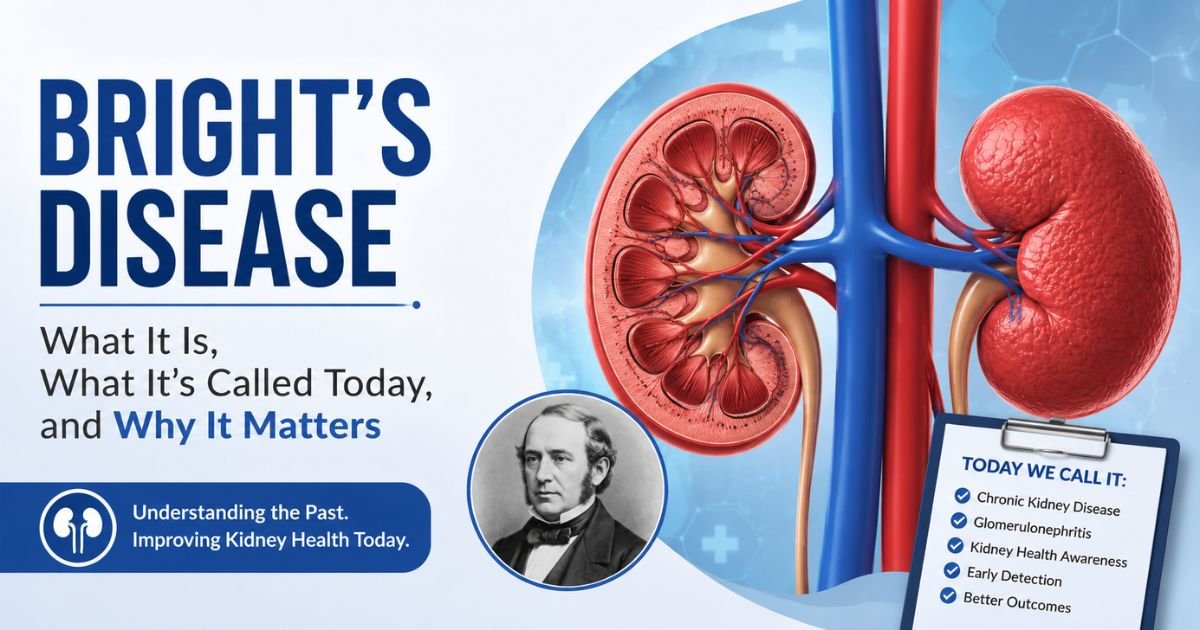
Bright’s disease is an old medical term for kidney inflammation, first described by Dr. Richard Bright in 1827. Doctors no longer use this name today, the same condition falls under nephritis, a group of kidney disorders that includes glomerulonephritis and chronic kidney disease. The term faded out by the mid-1900s as medicine learned to tell the different kidney conditions apart.
What Is Bright’s Disease?
Bright’s disease is a historical name for kidney inflammation, marked by swelling (edema) and protein in the urine (albuminuria). It wasn’t one single disease it was a catch-all term doctors used for a whole range of kidney problems that shared similar symptoms.
Dr. Richard Bright, a physician in London, first connected these symptoms to kidney damage in 1827. Before his work, doctors called the swelling “dropsy” without knowing what caused it. Bright’s discovery linked the swelling to what was happening inside the kidneys and that link became the foundation of modern nephrology, the branch of medicine focused on kidney health.
What Do We Call Bright’s Disease Today?

Bright’s disease is now called nephritis inflammation of the kidneys. Modern medicine has since split nephritis into more specific types based on cause and location, including:
- Glomerulonephritis inflammation of the kidney’s filtering units (the most common type)
- Interstitial nephritis inflammation in the space between the kidney’s tubes
- Pyelonephritis kidney inflammation from an untreated urinary tract infection
- Lupus nephritis kidney inflammation caused by lupus, an autoimmune condition
The name “Bright’s disease” stuck around informally through the 1940s, but it gradually disappeared from medical use as doctors gained the tools to diagnose these conditions individually instead of lumping them together.
Symptoms of Bright’s Disease
The symptoms doctors associated with Bright’s disease in the 1800s are still recognized today as signs of kidney inflammation:
- Edema swelling, especially in the face, hands, ankles, and feet
- Albuminuria protein (albumin) showing up in the urine
- High blood pressure
- Fatigue
- Reduced or changed urine output
- Nausea and headaches in more advanced cases
In severe 19th-century cases, doctors also documented apoplexy, convulsions, and coma signs of how far kidney failure could progress without modern treatment options like dialysis.
What Causes It? Then vs. Now
| 1800s understanding (Bright’s disease) | Modern understanding (nephritis) | |
| Believed cause | Unclear often blamed on “cold,” poor diet, or blood disorders | Infections, autoimmune conditions, diabetes, high blood pressure, genetic factors |
| Diagnosis method | Heat and nitric acid tests on urine samples (to detect albumin) | Urinalysis, blood tests, imaging, kidney biopsy |
| Classification | One broad disease | Multiple distinct conditions (glomerulonephritis, interstitial nephritis, etc.) |
| Treatment | Bloodletting, warm baths, diuretics, dietary changes | Blood pressure medication, immunosuppressants, dialysis, transplant |
Is Bright’s Disease Still Diagnosed Today?
No doctors don’t diagnose “Bright’s disease” anymore. The name is considered obsolete. If someone today has the symptoms once grouped under that label, they’d receive a specific modern diagnosis instead, such as glomerulonephritis, chronic kidney disease, or lupus nephritis, based on what’s actually causing the kidney inflammation.
This shift matters because a precise diagnosis leads to a precise treatment. Someone with lupus nephritis needs a very different treatment plan than someone with pyelonephritis, even though a 19th-century doctor might have labeled both “Bright’s disease.”
Richard Bright The Physician Behind the Name
Richard Bright practiced medicine in London and published his findings in Reports of Medical Cases between 1827 and 1831. He documented 25 patient cases of dropsy and traced the swelling back to kidney damage a connection no one had firmly established before.
His work earned him the informal title “godfather of nephrology.” Later research by other physicians expanded on his findings, linking Bright’s disease to cardiac hypertrophy (an enlarged heart) and high blood pressure connections that still hold up in how doctors understand kidney-heart health today.
Famous People Who Died of Bright’s Disease
Because the term was in everyday medical use for over a century, it appears in the biographies and death records of several notable historical figures, including:
- President Chester A. Arthur diagnosed in 1882, died less than two years after leaving office
- Alice Hathaway Roosevelt Theodore Roosevelt’s first wife, who died just two days after giving birth
- Emily Dickinson the American poet, who died in 1886
- Sir George-Étienne Cartier a Canadian statesman
A quick heads-up on accuracy: in several of these historical cases, the exact modern diagnosis is uncertain, since 19th-century testing couldn’t pinpoint the specific type of kidney disease the way modern tests can.
How Was It Treated in the 1800s vs. Now?
Doctors in Bright’s era had very limited tools. Acute cases were treated with warm baths, diuretics, and sometimes bloodletting to lower blood pressure. Chronic cases had no real cure treatment focused on diet changes, like cutting out alcohol, cheese, and red meat, to ease strain on the kidneys.
Modern treatment looks completely different. Depending on the specific type of nephritis, doctors now use:
- Blood pressure medications (like ACE inhibitors)
- Diuretics to manage swelling
- Immunosuppressants or corticosteroids for autoimmune-related kidney inflammation
- Antibiotics if an infection is the underlying cause
- Dialysis or kidney transplant in advanced kidney failure
Conclusion
Although the term Bright’s disease is no longer used in modern medicine, it remains an important part of medical history because it helped shape our understanding of kidney disease. Today, conditions once grouped under Bright’s disease are diagnosed more precisely as disorders such as glomerulonephritis or chronic kidney disease. Recognizing the historical term and its modern equivalents can help patients better understand older medical records and appreciate advances in kidney diagnosis and treatment.
FAQs
Is Bright’s disease the same as kidney failure?
Not exactly. Bright’s disease describes kidney inflammation, which can lead to kidney failure if untreated, but the terms aren’t interchangeable. Modern kidney failure is diagnosed and staged with specific tests Bright’s era didn’t have.
Is Bright’s disease hereditary?
Some causes of nephritis today have a genetic component, but “Bright’s disease” itself wasn’t defined precisely enough as a single condition to call it hereditary as a whole.
Who named Bright’s disease?
It’s named after Dr. Richard Bright, an English physician who linked kidney damage to dropsy and albuminuria in his 1827 publication, Reports of Medical Cases.
Why did doctors stop using the term “Bright’s disease”?
As medicine advanced, doctors realized “Bright’s disease” covered many different kidney conditions with different causes. More precise names like glomerulonephritis and lupus nephritis replaced it so patients could get more targeted treatment.
What’s the modern equivalent of Bright’s disease?
The closest modern equivalents are nephritis, glomerulonephritis, and chronic kidney disease, depending on the specific symptoms and underlying cause.
