
Minimizing interruptions during chest compressions while using an AED is very important. Every second counts when the heart stops, so pauses should be as short as possible. Compressions should restart immediately after the AED check or shock to keep blood flowing and improve survival chances.
What Does “Minimizing Compression Interruptions” Actually Mean?
Minimizing interruptions in compressions when using an AED means keeping chest compressions running continuously — pausing only when the AED actively analyzes heart rhythm or delivers a shock. The AHA’s 2025 Guidelines recommend limiting all pauses to under 10 seconds, with a target of under 5 seconds wherever possible.
Understanding Minimizing Compression Interruptions
“Minimizing compression interruptions” refers to reducing disruptions that occur during data compression processes. Compression is used to shrink file sizes for faster transmission and efficient storage, but interruptions—such as system lag, unstable connections, or processing delays—can negatively impact performance. When these interruptions are minimized, the compression process becomes smoother, faster, and more reliable. This is especially important in streaming, file transfers, and real-time applications where delays can affect user experience.
Why It Matters and How It Works
Minimizing compression interruptions ensures consistent data flow and better system efficiency. It helps prevent issues like corrupted files, buffering, or incomplete data transfers. This can be achieved through optimized algorithms, stable network connections, efficient hardware usage, and proper resource management. By reducing interruptions, systems can maintain high performance, improve speed, and deliver a seamless experience to users.
The Core Recommendations: What You Should Actually Do
Most guides hand you a bullet list. That’s not enough. What you need is the sequence — what happens when, and why each timing decision matters.
How-To Block (Featured Snippet B) Minimizing Compression Interruptions with an AED:
To minimize interruptions in compressions when using an AED, follow these steps:
- Begin compressions immediately. Don’t wait for the AED to arrive.
- Have a second person retrieve and power on the AED while compressions continue.
- Apply AED pads to the patient’s bare chest without stopping compressions.
- Continue compressions while the AED charges — stop only when it signals “stand clear.”
- Deliver the shock. Resume compressions within 5 seconds of shock delivery.
- Maintain a 100–120 compressions-per-minute rate; use a metronome or feedback device.
Look if you’re alone with no backup, step 2 changes. You’ll need to briefly pause to power the AED and apply pads yourself. Do it fast. Every second counts, and the AED’s voice prompts will guide you through it.
The Compressions During Charging Technique What Most Articles Skip
Here’s the thing: one of the highest-impact techniques for maintaining compression fraction is almost never explained clearly in beginner-facing content.
Modern AEDs like the Philips HeartStart FRx and the ZOLL AED 3 allow compressions to continue while the device is charging. The AED charges its capacitor (takes 5–15 seconds depending on the model) and only requires you to stop when it’s ready to deliver the shock. That’s the pause. Not before.
Most untrained bystanders stop compressions the moment the AED powers on. That’s the wrong instinct and it’s understandable, but it costs precious seconds.
ZOLL AED 3 vs. Philips HeartStart FRx: Which Supports This Better?
- Comparison Block (Featured Snippet C): ZOLL AED 3 vs. Philips HeartStart FRx: The ZOLL AED 3 is better suited for workplaces and first-responder teams because it includes a built-in real-time CPR feedback sensor and visual metronome that actively coaches compression rate and depth. The Philips FRx works better for environments needing a compact, simple device — its SMART Pads Cartridge system speeds up pad application. The key difference is active feedback during compressions versus faster pad setup.
Quick Comparison Table
| AED Model | Best For | Key Benefit | Limitation |
| ZOLL AED 3 | Workplaces, trained responders | Real-time CPR feedback + metronome | Bulkier than consumer models |
| Philips HeartStart FRx | Gyms, schools, solo bystanders | Fast pad setup, compact design | No built-in compression coaching |
| Philips HeartStart OnSite | Home/community use | Consumer-friendly design | No advanced feedback sensor |
| Laerdal CPR Feedback Device | Training simulations | AHA-certified training tool | Not a standalone AED |
Single-Rescuer vs. Multi-Rescuer Protocol This Changes Everything
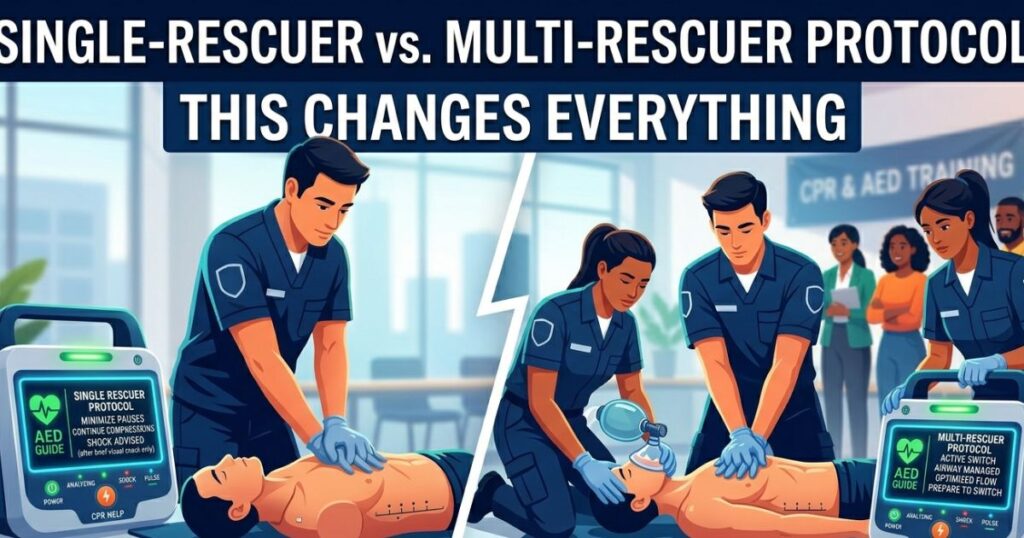
This is the gap neither competitor covers. The protocol is not the same when you’re alone.
- Two or more rescuers: One person maintains compressions without stopping. A second retrieves the AED, powers it on, exposes the chest, and applies pads — all while compressions continue. Roles are assigned before anyone touches the patient if possible. Loud, clear communication: “I’m on compressions. You get the AED. Call it out when you’re ready to apply pads.”
- Single rescuer: You must pause compressions briefly to power on the AED and apply pads. The AHA acknowledges this reality in its 2025 guidelines. Don’t freeze — move with purpose. Apply both pads, power on, then return to compressions immediately while the AED analyzes. The device’s voice prompts will tell you when to stand clear.
- Laerdal CPR feedback devices, used widely in AHA-certified training programs, are specifically designed to help rescuers practice both scenarios solo and team with real-time compression quality data. Simulation training is where single-rescuer confidence actually gets built.
What the 2025 AHA Guidelines Changed (And Why It Matters for This Topic)
I’ve seen conflicting data on this some older training materials cite the 2020 guidelines as current, while the updated 2025 framework introduced meaningful changes. My read is that the 2025 update is now the standard, and the differences are relevant.
The 2025 AHA Guidelines (released October 22, 2025, in Circulation) introduced a unified Chain of Survival that now applies to adults, children, and newborns across both in-hospital and out-of-hospital settings. Previously, separate chains existed for each population. This consolidation means the sequence — early recognition, high-quality CPR, early defibrillation — is now the universal standard.
Two specific updates affect compression interruptions directly:
- Compression depth: The 2025 guidelines maintain a depth of at least 2 inches (5 cm) for adults, but now emphasize an upper ceiling of 2.4 inches (6 cm). Exceeding this causes rib and organ injuries without improving blood flow. Depth matters — but so does the limit.
- Compression rate: Still 100–120 per minute for all age groups. No change here, but the guidelines now more strongly advocate for real-time feedback devices to maintain this range accurately during AED deployment.
What most guides skip: going too fast (above 120/min) actually reduces compression effectiveness because the heart doesn’t have time to refill between beats. The metronome on the ZOLL AED 3 helps prevent this.
Some experts argue that maximizing compression fraction is the single most important CPR quality metric. That’s valid for shockable rhythms like ventricular fibrillation. But if you’re dealing with non-shockable arrest, ventilation quality becomes more equally weighted — and compression-only CPR has its limits. This guide focuses on the AED-use scenario, where shockable rhythms are the primary target.
Common Mistakes That Create Unnecessary Pauses
Real talk: most compression interruptions aren’t caused by the AED. They’re caused by the rescuer.
Stopping to check for a pulse
Research cited in PMC shows pulse checks interrupt compressions by up to 24 seconds. The AHA’s guidance is clear: unless you’re a trained healthcare provider following a specific protocol, skip the pulse check and keep compressing.
Waiting for AED pads to be applied before resuming compressions
Pads can be applied while compressions continue. The gel on AED pads is conductive — it won’t disrupt the pad-placement process if someone is compressing while a second person applies.
Stopping compressions to “make room” for the shock
Stand clear doesn’t mean stop early. Compressions sho0uld continue until the AED says “analyzing” or “stand clear” not when you think it might say it soon.
Switching compressors without a clean handoff
Compressor fatigue is real. Switches should happen fast, at the 2-minute cycle mark when possible. The incoming compressor places hands before the outgoing one lifts theirs.
Conclusion
Minimizing interruptions in chest compressions during cardiac arrest is critical because every pause reduces blood flow to the brain and heart. The effective use of an Automated External Defibrillator should be integrated smoothly into CPR without unnecessary delays. The key is preparation, teamwork, and quick action—compressions should resume immediately after shock delivery or rhythm analysis. High-quality CPR with minimal pauses significantly improves survival chances and patient outcomes.
FAQs
What’s the best way to minimize interruptions in compressions when using an AED?
Apply AED pads while compressions continue, keep compressing during AED charging, and pause only for rhythm analysis and shock delivery keeping all pauses under 10 seconds per AHA 2025 guidelines.
How do I use an AED without stopping chest compressions?
If there are two rescuers, one maintains compressions while the other applies the AED pads. Continue compressing while the AED charges. Stop only when the device says “stand clear.
Should I stop CPR when the AED is analyzing?
Yes briefly. The AED needs a motion-free period to detect heart rhythm. This pause should last only as long as the device requires, typically 5–10 seconds, then compressions resume immediately.
Why does minimizing compression interruptions matter during AED use?
Every second compressions stop, blood pressure drops and organ perfusion falls. According to the AHA, survival decreases roughly 10% for every minute without CPR. High compression fraction is directly linked to better outcomes.
When should I resume compressions after an AED shock?
Immediately within 5 seconds of shock delivery. Don’t wait to check for a pulse or signs of life. Resume the 30:2 cycle or continuous compressions and reassess at the 2-minute mark.
