
Before touching a person in an emergency, certain legal and ethical steps are important to ensure you are protected and acting correctly. In most situations, you should first check for danger, call emergency services, and seek the person’s consent if they are conscious. If the person is unconscious or unable to respond, implied consent is generally assumed, allowing you to provide help. Understanding these basic legal requirements helps you assist safely without risking legal issues.
What Consent Actually Means in an Emergency
If the person is conscious and responsive, walk up calmly, identify yourself, and ask. Something like: “My name is Sarah. I’m CPR certified. Are you okay with me helping you?” That’s express consent. They say yes or they nod and you’re legally covered to proceed.
If they say no, you stop. Full stop. A conscious adult has the legal right to refuse care, even life-saving care. You can stay nearby, monitor, and call 911 but you cannot touch them against their will. Doing so could technically constitute battery under civil law, regardless of your intentions.
What are you legally required to do before you touch a person when responding to an emergency? Before touching any conscious person in a medical emergency, you are legally required to identify yourself, disclose your level of training, describe what you intend to do, and receive their verbal or implied permission. According to the American Heart Association’s 2025 Guidelines for CPR & Emergency Cardiovascular Care, consent, duty to act, and rescuer protection remain central principles in all bystander response training.
When You Can’t Get Consent And What Implied Consent Covers
In these situations, implied consent applies automatically. The legal logic is straightforward: a reasonable person in immediate danger would want help if they could ask for it. Since they can’t ask, the law answers for them.
You don’t need to wait. You don’t need a family member present. You don’t need to locate paperwork. Under implied consent, you are both legally permitted and ethically expected to begin life-saving care immediately call 911, start CPR if trained, use an AED if one is available.
One important exception: DNR (Do Not Resuscitate) orders. If a visible, documented DNR is present a medical alert bracelet, a card, a document on the person — medical professionals are legally bound to honor it. Bystanders who don’t know about a DNR and act in good faith are generally protected. But if you’re a healthcare provider and the order is clearly visible, you cannot override it.
When a person is unconscious or cannot respond during an emergency, implied consent legally allows any bystander to provide life-saving care without obtaining explicit permission. According to the American Red Cross CPR and First Aid training curriculum, this principle exists specifically to prevent legal hesitation from delaying emergency response. The only exception is a clearly visible Do Not Resuscitate (DNR) order, which trained medical professionals are required to respect.
The Step-by-Step Legal Process Before You Touch Anyone
To legally and safely respond to a medical emergency before touching the victim, follow these steps:
- Assess the scene confirm it is safe for you to approach
- Check responsiveness tap the shoulder, ask “Are you okay?”
- If conscious: introduce yourself, state your training, ask for consent
- If unconscious: invoke implied consent and begin care immediately
- Call 911 or direct a specific bystander to call while you assist
- Use PPE gloves or a CPR barrier mask if available
- Stay until EMS arrives do not leave once you’ve begun providing care
Abandonment is a real legal risk
If you begin providing care and then leave before qualified help arrives, you may have removed the person from a position where they’d seek other help and courts have treated that seriously. Starting aid creates a responsibility to see it through to handoff. Walk away mid-rescue, and your Good Samaritan protection can evaporate.
Good Samaritan Laws What They Protect, What They Don’t
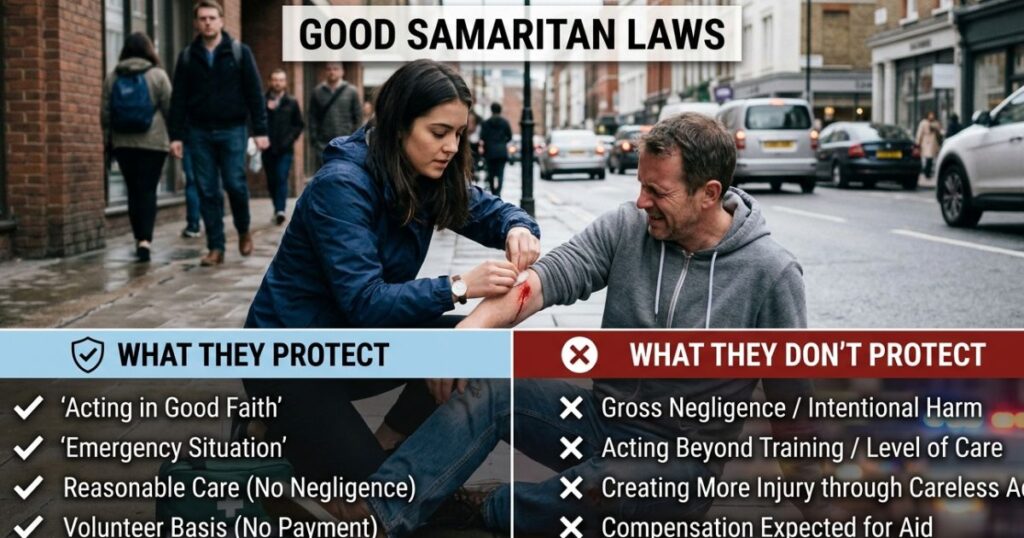
Every U.S. state has a Good Samaritan law. They all do roughly the same thing: shield you from civil liability if you help someone in good faith, within your training, without expecting payment.
Break a rib during CPR? Protected. Crack a tooth using a jaw thrust? Protected. These are predictable outcomes of emergency care, and courts know it.
- Gross negligence knowingly performing a procedure you have no business attempting
- Expecting compensation in some states, even accepting a gift afterward can nullify protection
- Abandonment leaving before EMS arrives after you’ve begun care
- Acting outside your training —a bystander who attempts a tracheotomy is not covered
Look if you’re CPR certified and you follow your training, you’re protected. The law is built for exactly this situation.
Good Samaritan laws in all 50 U.S. states protect bystanders who provide emergency care voluntarily, in good faith, and within their level of training. According to the Emergency First Response organization, to qualify for this protection you must ask permission if the person is conscious, act according to any training you have received, and provide help without expecting reward.
The Gender Gap Nobody Talks About
According to the American Heart Association (2024), only 39% of women receive bystander CPR in public settings, compared to 45% of men. The gap isn’t about who collapses more. It’s about who bystanders feel comfortable touching.
Fear of accusations of inappropriate contact, of causing harm is actively reducing survival rates for women. The legal framework exists precisely to remove that fear. Consent, properly obtained, protects everyone: the rescuer and the victim.
State-by-State Variation One Thing Competitors Miss
Quick Comparison:
| Scenario | Most U.S. States | MN, RI, VT | Healthcare Professionals |
| Legal duty to help | None voluntary | Required by law | Varies by state & employment |
| Protection type | Civil liability only | Civil liability | Civil + professional standards |
| DNR obligation | Not required to know | Not required to know | Must honor if visible |
| AED use protection | Yes, in most states | Yes | Yes |
| Abandonment risk | Yes if care started | Yes | Yes — stricter standard |
Some experts argue that duty-to-act laws in states like Vermont are an overreach that forcing intervention creates its own liability complications. That’s a valid concern for policymakers. For the person standing over someone having a cardiac arrest in Burlington? The practical answer is: help, and you’re covered.
Documentation After the Fact
Write down what you did even on your phone’s notes app. Time you arrived, what you observed, when you called 911, what care you provided, whether consent was given or implied. This isn’t paranoia. It’s protection.
For bystanders, it’s less formal but still useful. If questions arise later, a timestamped note on your phone is evidence of good-faith, orderly action.
Conclusion
In emergency situations, understanding what is legally required before touching a person is essential for both safety and protection. Checking for danger, calling for help, and recognizing implied consent can help you respond confidently without legal risk. By following these basic guidelines, you can provide life-saving assistance while staying within legal and ethical boundaries.
FAQs
What do you legally have to do before giving someone CPR?
If they’re conscious, identify yourself, state your training, and ask permission. If they’re unconscious, implied consent applies you can begin CPR immediately without asking.
Can I get sued for helping someone in an emergency?
Good Samaritan laws in all 50 states protect bystanders who help in good faith, within their training, and without expecting payment. Lawsuits against Good Samaritans are extremely rare.
What is implied consent in a medical emergency?
Implied consent means the law assumes an unconscious or unresponsive person would want life-saving help if they could agree. It allows bystanders to act immediately without waiting for permission.
Should I start CPR if someone has a DNR?
If you’re a bystander unaware of the DNR, Good Samaritan law generally protects you. Medical professionals with a clearly visible DNR order are legally required to honor it.
When does Good Samaritan protection NOT apply?
Protection does not cover gross negligence, procedures beyond your training, accepting payment, or leaving a victim before EMS arrives after you’ve already begun care.
